
Dear Sandro, Hail Mary.
First of all thank you for your compliments and trust.
Allow me also to make a necessary rectification. In the article you refer
to, there is in fact a mistake and we are providing the correction. We
cannot say that, being the Church the only true, there is consequently one
only God. It is the opposite that should have been written: for there is one
only God, there can only be one true Church.
Now I begin to answer your question: if in the First Commandment of God's
law it was forbidden to make images why does the Catholic Church allow them?
As you well recall, the First Commandment of Law, given by God to Moses at
the Sinai, says: “Thou shalt not have strange gods before me. Thou shalt not
make to thyself a graven thing, nor the likeness of any thing that is in
heaven above, or in the earth beneath, nor of those things that are in the
waters under the earth. Thou shalt not adore them, nor serve them” (Ex. XX,
3-5 and Deut. V, 8). In the book of Deuteronomy, God repeats this
prohibition saying: “Neither shalt thou make nor set up to thyself a statue:
which things the Lord thy God hateth” (Deut.XVI, 22) Based on these excerpts
from Bible, Protestants of all sorts – repeating the heresy of the
Iconoclasts – accuse the Catholic Church of rejecting God's order because
she allows the set up of sculptures and images from Christ and the saints,
for venerating them.
This reasoning of the heretics is false, because it puts these excerpts
apart from others. If there were only these sentences in the Scriptures
regarding images, they would be right. Happens, though, that the same God
who gave this law, said, or at least appears to have said the opposite in
other passages. Thereby, let us see: in same book of Exodus when God – whose
first commandment forbids to make sculptures from any thing that is in
heaven above – commanded the construction of the Ark of the Covenant in
order to keep the Tables of the Law into it, He says: “Thou shalt make also
two cherubims of beaten gold, on the two sides of the oracle. Let one cherub
be on the one side, and the other on the other. Let them cover both sides of
the propitiatory, spreading their wings, and covering the oracle, and let
them look one towards the other, their faces being turned towards the
propitiatory wherewith the ark is to be covered. In which thou shalt put the
testimony that I will give thee. Thence will I give orders, and will speak
to thee over the propitiatory, and from the midst of the two cherubims,
which shall be upon the ark of the testimony, all things which I will
command the children of Israel by thee” (Ex. XXV, 17-22). These words will
be repeated in Ex. XXXVII, 7.
Now then, if God had forbidden the set up of images “of any thing that is in
heaven above”, how come He commands to carve images of two cherubims,
assigning them to be placed exactly above the ark where it would be kept the
Law that forbade the making of statues? It appears to be a contradiction,
but in God there cannot be contradiction. Therefore, there should be an
explanation for the making of statues. What would it be?
There are also many other passages in which God commands the erection of
sculptures. Here are some of them: In the Book of Numbers, when the Jews
rebelled against God for drawing them from Egypt, God punished them with
serpents. And the people begged Moses to intercede for them before God
saying: “pray that he may take away these serpents from us. And Moses prayed
for the people. And the Lord said to him: Make a brazen serpent, and set it
up for a sign: whosoever being struck shall look on it, shall live. Moses
therefore made a brazen serpent, and set it up for a sign: which when they
that were bitten looked upon, they were healed.” (Num.XXI, 7-9).
Once again: if God has forbidden the carving of figures and sculptures of
any thing that is in the earth beneath, how come then that He ordered Moses
to make a brazen serpent? And what's more: whoever stared at the serpent
became healed. That would occasionally give to the humblest Jews the idea –
that would be a temptation – that there was something spiritual or divine
about the serpent that would make it capable of healing.
Can there be any contradiction in God? Of course not. So there must be some
explanation to it: God forbids the making of images and at the same time
demands the making of images. And one of them, an image of a serpent that
heals by being looked at.
Notice also – by the way – that this last excerpt shows that the Bible
admits human intercessors before God, opposed to what erroneously teach
protestants of all sects, which do not admit intercessors of any sorts… When
God ordered the construction of the Temple, He ordered the making of a
molten sea, that is to say, a great molten bowl, and said: “And it [the sea]
stood upon twelve oxen, of which three looked towards the north, and three
towards the west, and three towards the south, and three towards the east:
and the sea was above upon them, and their hinder parts were all hid within.”(I
Kings, VII 25).
How can the same God who, in the Sinai, had forbidden carvings of all things
that there is on earth, command the Jews to make twelve oxen? After all, is
it forbidden or not the making of sculptures?
What a confusion the Protestants make by reading isolated sentences of the
Bible, and putting others aside deliberately!
On describing the molten sea, the Bible says: “And the work itself of the
bases, was intergraven: and there were gravings between the joinings.
And between the little crowns and the ledges, were lions, and oxen, and
cherubims; and in the joinings likewise above: and under the lions and oxen,
as it were bands of brass hanging down” (I Kings, VII 28-29).
In the First Book of Chronics, or of Paralipomenon, as well as in the First
Book of the Kings, one can see other particularities about the sculptures
that God commanded to be made by order of Salomon, for the Temple of God in
Jerusalem.
“And he made in the oracle two cherubims of olive tree, of ten cubits in
height.” (…) “And all the walls of the temple round about he carved with
divers figures and carvings: and he made in them cherubims and palm trees,
and divers representations, as it were standing out, and coming forth from
the wall” (…) “And two doors of olive tree: and he carved upon them figures
of cherubims, and figures of palm trees, and carvings very much projecting;
and he overlaid them with gold: and he covered both the cherubims and the
palm trees, and the other things, with gold.” (…) “And he carved cherubims,
and palm trees, and carved work standing very much out;” (I Kings VI, 23-24;
29; 32; 35).
“For fleshhooks also, and bowls, and censors of fine gold, and for little
lions of gold, according to the measure he gave by weight, for every lion.
In like manner also for lions of silver he set aside a different weight of
silver. And for the altar of incense, he gave the purest gold: and to make
the likeness of the chariot of the cherubims spreading their wings, and
covering the ark of the covenant of the Lord.”(I Chr XXVIII, 17-18)”.
When the Ark of the Covenant fell into the hands of the Philistines, God
punished them with a curse. In order to get rid of it, the Philistines
consulted their soothsayers, who ordered them to make five golden objects
representing the part of body affected by the plague, and five golden rats,
placing these by the Ark, over an oxcart, letting it free for go off. And
the oxcart went towards the Jews who recovered the Ark.
Now, the fact that God attended the Philistines, healing them, evidences
that He accepted the gift of five golden rats and five golden objects
representing the part affected by the plague. It follows that not always
sculptures are condemnable.
All these quotations prove that, if God has prohibited in the First
Commandment the making of sculptures and images, on the other hand He had
commanded, in other occasions, and for several times, that figures and
sculptures were constructed. Again: how can one explain this apparent
contradiction, since in God there cannot be contradiction? It's not
difficult to explain.
A prohibition can be of two kinds: it can be an absolute prohibition or a
relative one.
Consider for instance a teacher who, angry because of the noise in his class,
shouts: “I forbid you all to open your mouths!” Next he calls one of his
students (let us call him Bob) and asks him for a lesson, in an oral test.
He asks the child something, but the boy does not answer. He makes another
question, and Bob keeps his mouth shut. He asks for a third time, and the
student remains in absolute silence. Result: Bob fails the test.
Later on, the teacher catches another student eating a sandwich during class.
Angry again, the teacher forbids the students of eating from then on.
When classes are over, Bob goes home but he refuses to eat and to speak: he
keeps his mouth shut. His mother insists but Bob remains irremovable: his
mouth does not open. At last, he explains, in written, why he does not eat
nor speak: it is because the teacher had forbidden him to do so. That is why
he failed the oral test and why he refuses to eat anything.
Obviously Bob was little understanding… his teacher had forbidden the
students to open the mouth in class in the sense that it was forbidden to
chat, but not to repeat orally the lesson. He had prohibited eating during
class, but not at home. The teacher's prohibitions were relative
prohibitions, and not absolute ones. The teacher did not say any
contradiction. But Bob demonstrated lack of intelligence on understanding
prohibitions to the students during class as absolute prohibitions, valid
for ever and for all circumstances.
Likewise, if God forbade the making of images and, later on, in several
times, commanded the making of images, since there cannot be contradiction
in God, it follows that the prohibition for images is relative, and not
absolute.
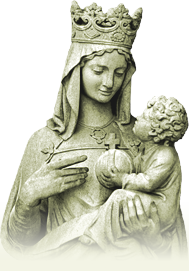
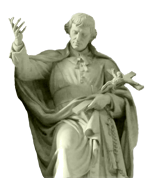
God has forbidden images for adoration. God has forbidden us to make
idols, and not images. That is why the Church, which comprehends and
accepts everything God said in the Holy Scriptures and which does not
isolate one sentence from another, but harmonizes them all, the Church has
always allowed the use of images and their veneration, but never their
adoration. By the way, all protestants in their day-by-day life disobey
what they consider to be the real interpretation of the first commandment,
because they take pictures of themselves and of their relatives, keep them,
and some of them even kiss these pictures, if they have affect for the
person photographed.
If they indeed believed that images of any thing are to be made, they could
never take pictures of anything. Neither would they have mirrors at home,
for images are formed on them.
Neither could they have children, for every man is made as an image of God.
There would be much more to say about it. For now that is enough. If you
have any other doubts about this theme or similar ones, write us and we will
be glad to answer.
In Corde Jesu semper,
Orlando Fedeli.